
The Whole Message: Dennis Gabor and the Science Beneath a Settled Mind

Updated: 3 days ago
New to this series? Start with One Question, Two Doors: Why This Series Exists, which lays out what this whole project is for.
You may be wondering why a website devoted to Yoga, Vedanta and contemplative wellbeing is about to spend several minutes on a Hungarian-British engineer and a piece of 1940s physics. It is a fair question, and it deserves a direct answer before we go anywhere near the science.
Our course, "The Mind in the Light of Modern and Spiritual Sciences," part of the Ritam Wellbeing Programme, is built on a single working conviction: that the great contemplative traditions and modern science are not describing two different worlds, one "spiritual" and one "real." They are often describing the very same structures in the very same mind, in two different languages. When Patanjali speaks of the mind's fluctuations settling into stillness, and a physicist speaks of a signal's frequency sharpening as its spread in time narrows, we have found, again and again in developing this course, that these are not just poetically similar. They are structurally the same claim, arrived at from two directions centuries apart. Seeing that clearly does something practical: it gives a modern, science-literate reader permission to take the contemplative claim seriously, and it gives a lifelong meditator a new, precise vocabulary for something they have already felt directly in practice.
Dennis Gabor is where this particular thread of our course begins. One scientist, two discoveries a year apart, one underlying idea, so simple it can be stated in a single sentence: you can never know exactly when something happens and exactly what pitch it is, both at once.
That sentence sounds abstract until you notice you already know it. Anyone who has ever tried to name the exact note a drumbeat is playing knows it. Anyone who has watched a bird call rise and fall and tried to say precisely when the "rising" ends and the "falling" begins knows it too. Gabor did not invent this trade-off. He proved that it is a law, gave it a precise mathematical shape, and then, a year later, found a way to use the very same idea to solve an entirely different problem: how to photograph the invisible.
The presentation below walks through this in five minutes, with two things worth actually touching yourself rather than reading about: the slider on the uncertainty-limit slide, which lets you feel the trade-off happen in real time, and the button that lets you cut a hologram in half and watch the whole scene survive anyway. Once you have the shape of it, the full essay below unpacks where this all came from, the history behind it, and exactly how it grounds two of our other contemplative presentations, and the actual practice of settling a restless mind.
The Man: An Engineer Who Thought Like a Physicist
Dennis Gabor was born Gábor Dénes in Budapest in 1900, into a Jewish engineering family in a city that, in the early twentieth century, produced an extraordinary run of scientific talent (Leo Szilard, Edward Teller and John von Neumann all came from the same milieu). He trained as an electrical engineer in Berlin through the 1920s, working at Siemens, where he built one of his first successful inventions, a high-pressure quartz-mercury lamp. When Hitler rose to power in 1933, Gabor's position was terminated within weeks. He fled to England and rebuilt his career from close to nothing, joining the British Thomson-Houston company (BTH) in Rugby, where he would remain for the next fifteen years, the only refugee employed in that research laboratory.
By his own account, and by the account of those who knew him, Gabor was restless in a specific way: an engineer's hands with a physicist's hunger for the law underneath the machine. He wanted to fix real, practical things (telephone lines, microscopes) but he could not stop himself reaching past the fix for the principle that made the fix necessary in the first place. This is, in a sense, the whole shape of this essay: a man solving two "merely practical" problems and discovering, both times, that he had touched something universal.
The two discoveries at a glance:
1946. A three-part paper titled "Theory of Communication" proves that time and frequency cannot both be pinned down precisely, and defines the smallest efficient unit of a signal, which Gabor named the logon.
1947–48. Working alone in the BTH laboratory on a stubborn problem in electron microscopy, Gabor invents holography: a way to record the whole of a wave, not just its brightness. He coins the word from the Greek holos (whole) and gramma (message, or that which is written).
1971. He receives the Nobel Prize in Physics for holography, twenty-four years after the original insight, once the technology finally caught up with the idea (more on that delay below).
It would be easy to read these as two unrelated party tricks from a clever mind. They are not. As this essay will show, they are the same insight, discovered twice, a year apart, under two completely different names.
The 1946 Question: How Much Can a Channel Carry?
Gabor's starting point in 1946 was thoroughly unglamorous: telephone engineering. How much information can a communication channel, a telephone wire, a radio band, actually carry? This was a live commercial and military question in the 1940s, with real bandwidth constraints on real infrastructure. To make progress on it, Gabor did something that had not quite been done with this rigor before: he refused to describe a signal in only one way. He insisted on holding two descriptions in mind simultaneously.
Every signal, it turns out, can be completely described in two different languages.
The time view. This is the description you already use, without thinking of it as mathematics. A voice rising and falling as someone speaks. A heartbeat's line on a monitor. A drumbeat you can point to on a clock and say "there, that instant." This is how we hear, and how we experience anything, moment to moment.
The frequency view. This is a different, equally complete description of the very same signal, but framed as a recipe of steady tones: how much of each pitch is present, added together, to make the whole. A tuning fork does not know or care "when" a sound happened; it only registers whether its own frequency is present in what it hears. A prism does the same thing to light: it does not care when the light arrived, only what colors (frequencies) it contains.
Neither view is more "real" than the other. A recording of a symphony and its full frequency spectrum are two complete descriptions of the identical piece of information, one organized by time, the other organized by pitch. Gabor's deep question was this: can a signal be pinned down precisely in both descriptions at once? Can you know exactly when something happened and exactly what frequency it was, with no blur in either?
Consider a piano, since it makes the tension vivid. Strike a key for the briefest possible instant, a fraction of a second, releasing it almost as soon as you touch it. You get a very sharp "when": there is no doubt about the exact moment the sound occurred. But the pitch is smeared, a percussive thud rather than a clean tone, because a signal that short simply does not contain enough oscillations to define a precise frequency. Now hold the same key down for several full seconds. The pitch becomes beautifully clear and pure. But the "when" has smeared in the opposite direction: the note is spread across that entire span, and you have lost the sense of a single sharp instant.
Gabor's answer, worked out with full mathematical rigor, was that you cannot have both. Not because pianos are imperfect instruments, but because it is a fact about waves and information themselves.
The Uncertainty Limit: Δt · Δf ≥ 1/4π
The precise statement Gabor proved is this: the spread in time (written Δt) multiplied by the spread in frequency (written Δf) can never fall below a fixed floor. In his own notation, Δt · Δf ≥ 1/4π. Sharpen the "when" and the "what pitch" necessarily blurs; sharpen the "what pitch" and the "when" necessarily blurs. Their product has a hard minimum. You are always trading one kind of clarity for the other, and there is no way to cheat the trade.
Here is the detail that genuinely surprised the physics world when people later noticed it: this is the identical inequality that Werner Heisenberg discovered in quantum mechanics two decades earlier, when he showed that a particle's position and momentum cannot both be known with unlimited precision. Yet Gabor derived his version for entirely ordinary sound and radio signals, where nothing quantum is involved whatsoever. It is, in other words, not a quirk of subatomic particles. It is a property of waves as such, wherever they occur, a fingerprint left by the mathematics of oscillation itself, whether that oscillation is an electron's wavefunction or a note played on a piano.
There is an even older thread worth knowing about, because it keeps this honest rather than mythologized: engineers researching telegraph pulse transmission, notably Karl Küpfmüller in 1924, had already stumbled on a version of this same trade-off between pulse width and bandwidth, possibly before Heisenberg's own 1927 paper. Gabor's contribution was not that he was first to sense the trade-off existed; it was that he gave it its most general, elegant, and widely applicable mathematical form, and then, unlike anyone before him, went on to build an entire theory of communication and, a year later, an entirely new branch of optics on top of it.
The Logon: The Most Efficient Grain of Information
Having proven the limit exists, Gabor asked a second, more creative question. If time and frequency precision cannot both be perfect, what is the most efficient signal possible, the one that sits exactly on the floor of the trade-off and wastes nothing?
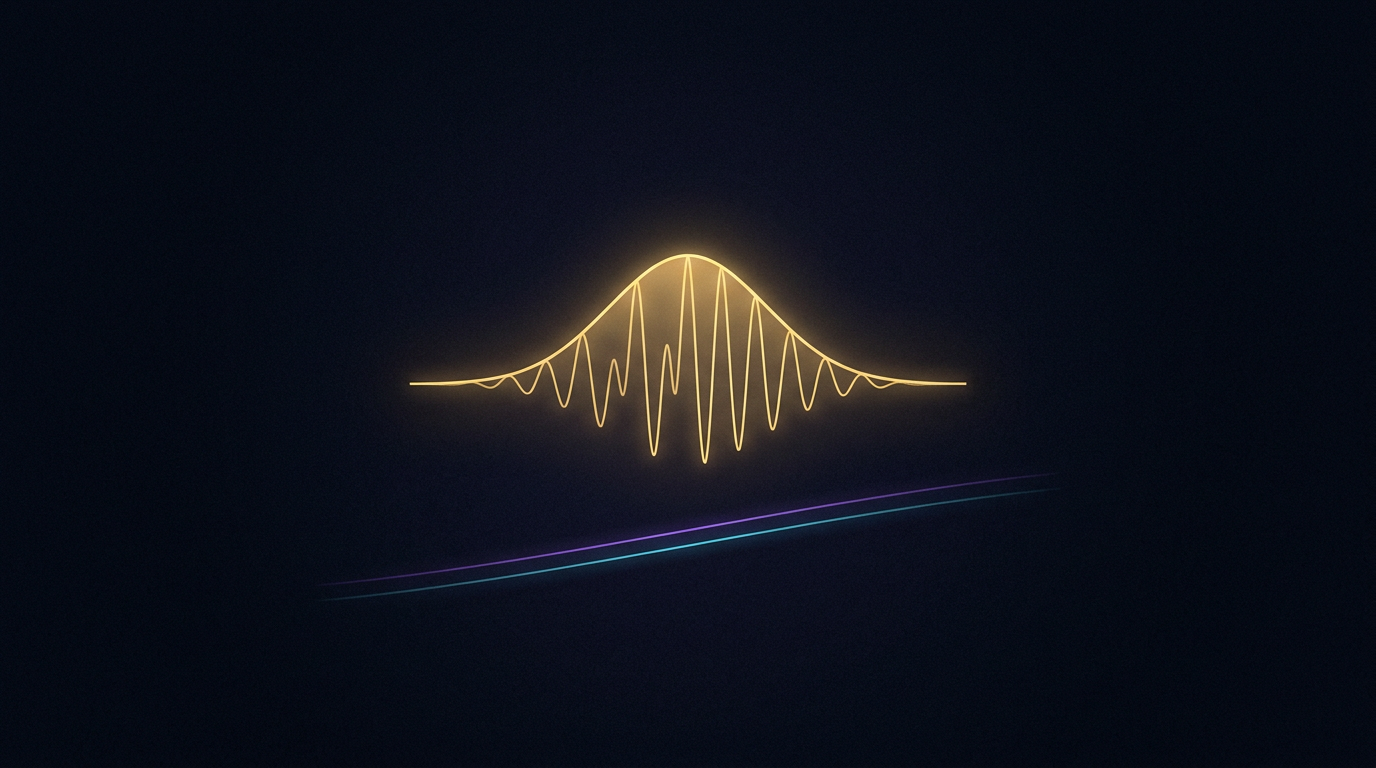
He proved there is a single, unique answer: a pure tone (called the carrier) held inside a smooth, bell-shaped envelope (a Gaussian curve, the same bell shape that appears throughout statistics). He named this elementary unit a logon. Mathematicians and engineers today more often call it a Gabor atom or Gabor function, and it has become the foundation for an entire field, Gabor analysis, that traces directly back to that 1946 paper. His claim was radical: any signal whatsoever, no matter how complex, could in principle be built by adding together these elementary grains, each one occupying a single irreducible cell in what he called the "information diagram."
This is not merely historical trivia. That same logon shape, a carrier riding inside an envelope, is the direct mathematical ancestor of wavelet analysis, the technique used today to compress audio into MP3 files, to power speech recognition systems, and, closer to home, to study how fast brain rhythms (like gamma oscillations) are nested inside slower ones (like theta oscillations) in neuroscience research on attention and memory. And, closer still to our own work: this carrier-in-envelope shape is exactly the structure of the resultant wave in the Ritam Mind Wave Equation, developed in Module 3 of The Mind in the Light of Modern and Spiritual Sciences. A settled thought, in that model, has precisely the anatomy of a Gabor logon: a pure carrier of content held inside an envelope of attention. We will return to this.
Here is why that matters beyond mathematics. In ordinary, scattered attention, every moment of experience is a wide, blurry logon, uncertain in both its content and its clarity, much like that piano key struck for a fraction of a second. The practices at the centre of Yoga, dharana and dhyana in particular, are, described in this language, a steady narrowing of that spread: not by force, but by holding attention in one place for longer, the same way holding a piano key down lets its pitch resolve into a single clear tone. This is not a metaphor we are imposing on the practice from outside. It is what the mathematics of the trade-off itself predicts should happen when attention steadies. The course, and the equation it develops, exists to make that connection precise rather than merely suggestive.
The 1947 Leap: The Problem of the Lost Phase
A year after "Theory of Communication," Gabor turned to a completely different, equally practical problem: the electron microscope. By 1947 the electron microscope had already improved on the best optical microscopes by a factor of one hundred, close enough to resolving individual atoms to be tantalizing, but not quite there. The obstacle was a stubborn optical flaw called spherical aberration in the microscope's magnetic lenses: narrow the aperture to reduce this aberration, and diffraction blurred the image instead; widen the aperture to reduce diffraction, and the aberration blurred it. Every adjustment traded one blur for another, an uncanny echo, in a completely different domain, of the very trade-off Gabor had already proven for time and frequency.
Gabor's own account of what happened next is worth knowing, because it is a wonderful, human story rather than an abstract equation. He described it in his 1971 Nobel lecture: he had been pondering the problem for a long time, and then, on Easter Sunday in 1947, while waiting for a game of tennis, the solution suddenly dawned on him. His question to himself was: why not take a bad electron picture, one that nonetheless contains the whole information, and correct it afterward by optical means?
To understand why this was such a leap, you need to know what a normal photograph, or a normal electron-microscope image, actually captures and what it necessarily throws away.
What gets recorded. Every ordinary detector, whether photographic film or an electron-sensitive plate, registers only intensity: how bright each point is. This is true of your eye, your camera, and the electron microscope's detector alike.
What gets lost. A wave also carries phase, the precise timing of where each crest and trough sits in its cycle. Phase is what encodes depth, the third dimension, the difference between "this point is bright because it is close and small" and "this point is bright because it is far and reflective." No ordinary detector can register phase directly; it is not a matter of poor equipment, phase is simply invisible to intensity-only measurement. This is precisely why a photograph is flat: it knows brightness perfectly and depth not at all.
Gabor's question, then, was genuinely radical: how do you record something that no detector, by its very nature, can see?
The Trick: Turning Timing into a Pattern
His solution was to stop trying to detect phase directly, and instead make it visible indirectly, by letting it interfere with something else. Take the wave scattered by the object you want to image, and let it meet a second, undisturbed reference wave, one with a known, steady phase of its own. Where the crests of the two waves align, they reinforce each other into a bright band. Where a crest meets a trough, they cancel into a dark band. The result is a pattern of bright and dark bands called interference fringes and, crucially, the exact spacing and shape of those fringes is a direct record of the timing difference, the phase, between the two waves. Something that phase itself could never do directly, ordinary photographic film now can: it can record where those fringes fall.
An everyday image makes this vivid. Drop two stones into a still pond a short distance apart and watch where their ripples cross. In some places the ripples pile on top of each other into a single tall peak. In other places a peak from one ripple meets a trough from the other and they flatten out entirely. This crisscross pattern is not random noise, it is an exact, physical record of precisely where each stone fell and precisely when, encoded in nothing more than the geometry of where the rings happen to overlap. Gabor's interference pattern works by exactly the same principle, just with light or electron waves instead of water.
Once you have that fringe pattern recorded on film (or, in Gabor's original electron-microscope conception, recorded and then illuminated afterward with visible light), you can shine the original reference wave back through it, and the object's original wave springs back into existence in full, three-dimensionally, exactly as if the object itself were still there. Gabor named the recorded pattern, and by extension the whole technique, from the Greek: holos (whole) and gramma (message or written record). The hologram: the record that, unlike a photograph, keeps the entire wavefront rather than a flat shadow of it.
The Signature Property: The Whole in Every Fragment
A hologram behaves in a way that seems, at first encounter, almost impossible. Cut an ordinary photograph in half, and you get exactly half the scene; the other half is simply gone. Cut a hologram in half, and, astonishingly, each half still displays the entire original scene, only somewhat less sharply, as if you were viewing it through a smaller window.
The reason is not mysterious once you see it from the frequency angle we have been building throughout this essay. A hologram is, in a very literal sense, a recording made in the frequency domain rather than the ordinary spatial domain of a photograph. In the frequency domain, information about any single point of the original scene is not stored in one place at all, it is spread, mathematically, across the entire recording surface. So any fragment you keep still carries traces of every point of the whole scene, simply at lower resolution, because there is less of the plate's area, and therefore less of the frequency information, in that fragment. "The whole in every part" is not a poetic flourish. It is a precise, unremarkable description of how frequency-domain storage behaves, once you understand the mechanism.
This same signature property, incidentally, is the direct scientific counterpart to a claim found independently in contemplative traditions we explore in our companion presentation, The Light and the Field: the Bhagavad Gita's description of ultimate reality as "undivided, yet appearing divided among beings," and Kashmir Shaivism's teaching (sarvaṁ sarvātmakam, "everything is of the nature of everything") that each part somehow enfolds the whole. We want to be careful and honest about what this parallel is and is not. It is a structural resemblance, a case where two very different traditions of inquiry, physics and contemplative philosophy, arrive at descriptions with the same shape. It is not a proof that the metaphysical claim is true, and it is not a claim that Vedanta or Kashmir Shaivism "predicted" holography. What we can honestly say is that the holographic principle removes one common objection to such teachings, namely that "whole in every part" sounds like a physical impossibility. It plainly is not; ordinary 1940s optics displays exactly that property.
Why the Two Discoveries Are One
At first glance Gabor might look like a scientist who simply moved from one clever problem to an unrelated one, telephones one year, microscopes the next. He did not. Both discoveries rest on the same underlying idea: information lives in the relationship between a signal and a reference, and it is most naturally organized in the frequency domain.
In 1946, the reference was a family of pure tones, and the lesson was that time and frequency trade off against each other, with the most efficient unit of information being a carrier held inside an envelope.
In 1947, the reference was a clean, undisturbed wave, and the lesson was that interference, recorded in the frequency domain, can capture and store an entire three-dimensional world, phase and all.
A hologram is, quite literally, a recording made in the spectral domain, which is precisely why every fragment of it carries the whole. It is the same underlying frequency-domain logic that carried Gabor across both of his breakthroughs, a year apart, under two entirely different names.
This is why our own two contemplative presentations are not simply linked by a shared theme or aesthetic. They are rooted in one scientific vision. The Settling Mind draws on the 1946 uncertainty limit, and the trade-off between clarity of "what" and clarity of "when" in the movement of thought. The Light and the Field draws on the 1947 holographic principle, and the possibility that a single field can enfold a whole world within each of its parts. Gabor's single underlying insight, that information organizes itself in the frequency domain, unifies both presentations at their root.
An Honest Footnote: The Idea That Waited for Its Light
Gabor's first working holograms, produced in 1948, were far from the vivid three-dimensional images we associate with the word today. They were muddied by an unavoidable flaw: a "twin image" problem, an overlapping ghost image that came bundled with the real one and could not easily be removed. The deeper issue was that ordinary light sources of the era, mercury lamps and the like, were simply not coherent enough: their light waves were not sufficiently pure and in-step with themselves to produce a clean interference pattern. Gabor had the principle exactly right. He did not yet have the light his principle required. The field lay almost entirely dormant for well over a decade.
Then, in the 1960s, the laser arrived: a source of light at a single, pure frequency, its waves marching perfectly in step with one another over long distances, in a word, coherent. With laser light finally available, Emmett Leith and Juris Upatnieks at the University of Michigan (and, independently, Yuri Denisyuk in the Soviet Union) produced the first vivid, genuinely three-dimensional holograms, the images that made the word "hologram" famous. Gabor had invented the principle nearly fifteen years earlier; the laser was what finally let it shine. His Nobel Prize came in 1971, twenty-four years after that Easter Sunday tennis-court epiphany.
There is a teaching worth sitting with here, distinct from anything about waves or optics as such: a genuinely correct and complete idea can still have to wait, sometimes for a generation, for the conditions that let it fully express itself. And what Gabor's idea was waiting for, specifically, was coherence: a single, pure, unbroken frequency, undisturbed by competing noise. That is not a bad description, as it happens, of what a settled mind becomes in meditation, and it is the thread we pick up directly in The Settling Mind.
What Gabor Gave Us
One mind, two discoveries. Dennis Gabor found the time-frequency uncertainty limit in 1946 and invented holography in 1947, an Easter Sunday insight born from a stubborn problem in electron microscopy. He won the 1971 Nobel Prize in Physics for the latter.
The limit: Δt · Δf ≥ 1/4π. Sharpness in time and sharpness in frequency cannot both be had. This is the same inequality Heisenberg found in quantum mechanics, but Gabor proved it for ordinary waves, with nothing quantum involved. The most efficient unit of information at this limit is a carrier held inside an envelope: the logon.
The hologram: the whole message. By letting an object's wave interfere with a clean reference wave, Gabor captured the otherwise invisible phase, and with it the whole wavefront, so that every fragment of the recording holds the entire scene.
Both are one insight. Information lives in the relationship between a signal and a reference, organized in the frequency domain. That single idea powers both of Gabor's breakthroughs.
The root beneath our work. The Settling Mind grows from the 1946 limit and the coherence a settled mind achieves. The Light and the Field grows from the 1947 hologram and the whole enfolded in every part. Gabor is the shared root of both.
This essay presents the history and physics of Dennis Gabor's work faithfully. The connections drawn here to contemplative models, in the Vedanta and Kashmir Shaivism traditions explored further in The Light and the Field, are offered as structural bridges for insight, not as claims that Gabor's mathematics proves any metaphysics.
Where to Go From Here
If this way of seeing the mind, as something with a genuine, describable structure rather than a vague inner fog, speaks to you, the Ritam Wellbeing Programme is built to take you further, at whatever pace suits you.
Understand the whole arc. One Question, Two Doors lays out why this series exists and where it is heading, so you can see the whole shape before choosing where to go next.
Start free. A short, free introduction to meditation and mind-management, including our podcast The Mind, a conversation where modern science meets Yoga and Vedanta to build a practical understanding of the mind, in plain language. No commitment required.
Build your foundation. The course this essay draws from, The Mind in the Light of Modern and Spiritual Sciences, develops the Ritam Mind Wave Equation introduced above in full, alongside the classical Yogic path of dharana, dhyana and samadhi read through this same lens. It is the fullest, most structured way to work through this material.
Practise in community. The Ritam Wellness Forum and our Ritam Yarning Circles are where this stops being theory: small, facilitated conversations where you bring your own questions, your own experience of practice, and your own doubts about how, or whether, any of this actually helps, and work through it together with others doing the same thing.
Go deeper. When you are ready, our Vedanta Wellbeing Retreat offers time away from daily life to let the practice settle in more fully.
None of this is meant to replace the practice itself. The mathematics in this essay describes what a settled mind looks like; it does not settle a mind. That part is still yours to do, one sitting at a time. What the science offers, at its best, is simply a clearer map of the territory you are already walking.
Everything in the Ritam Wellbeing Programme, the course, the podcast, the forum, is offered freely. If this essay or the presentation above was worth your time, the centre relies entirely on donations to keep doing this work.
A note on care: the Ritam Wellbeing Programme supports general wellbeing and personal growth. It is not a treatment for mental illness and is not a substitute for professional medical or psychological care. If you are struggling, please reach out to your doctor or a qualified professional. In New Zealand you can call or text 1737 any time to speak with a trained counsellor, free and confidential. In an emergency, call 111.

Comments