
The Inherited Mind: What You Are Carrying, and What You Are Feeding It

Updated: Oct 15
The previous essay in this series, The Groove That Runs Itself, asked why a small remark can produce a reaction far out of proportion to it, and answered with a filter: an impulse response, built by the past, invisible until something rouses it. That essay told you what was happening. It did not tell you where the filter came from, or what you might do about it. This essay asks both. Not why did you react like that, but where did that particular shape of reacting come from, and what, right now, today, are you doing that is quietly building the next version of it.
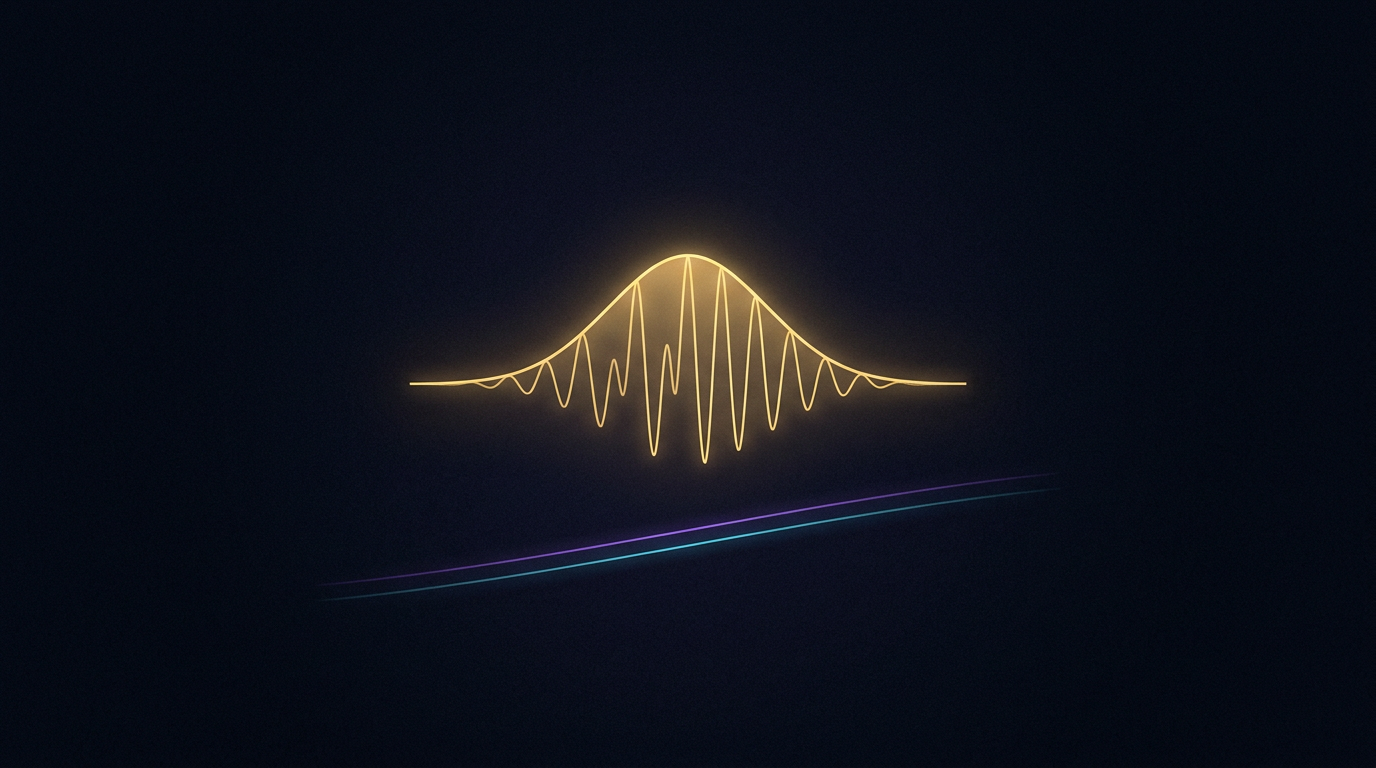
The mechanism is the same one as before, h(t), the term in the wave equation that essay opened. But the question has changed register. A single reaction is an event. A disposition is a history, and a history, unlike a single event, is something you are still writing, one ordinary day at a time, mostly without noticing.
The presentation above lets you build one. It is not a filter you set by hand this time. You choose what a stretch of days is made of, agitating, dulling, steadying, run it forward, and watch the three numbers from the essay The Groove That Runs Itself, overshoot, settling time, residual ripple, assemble themselves as a result rather than as something you dialled in. Try a month of conflict against a month of quiet practice and watch what each becomes. Then read on, because the essay below explains why that is not a metaphor.
Arun's ordinary Tuesday
Nothing has happened to Arun. That is the point of starting with him.
He is thirty-six, his job is fine, his marriage is fine, nobody in his life would describe him as struggling. He wakes most mornings already faintly braced, for what he could not say. He checks his phone before his feet are on the floor. He works through a feed in most of the gaps in his day, the queue at the coffee machine, the walk between meetings, the ten minutes before a call starts. In the evening there is more of the same, ending some nights close to midnight, the last thing his eyes do before they close.
If you asked Arun what was wrong, he would struggle to answer, because nothing is wrong in the way a single bad thing is wrong. There was no roster incident, no sharp word he regrets. There is instead a low, constant hum of unease with nothing obvious attached to it, a sense that everything is slightly closer to the edge than it used to be, and no memory of when that became true.
The essay The Groove That Runs Itself gave you the vocabulary for this. Arun is not overshooting. He is carrying residual ripple, activation with no trigger present. What that essay did not explain is how a person arrives there with nothing dramatic in their history to blame. This essay is that explanation, and the answer was never a mystery. It has a name in the Yoga tradition, and a substantial body of research behind it in ours.
The wave that becomes fine, but does not disappear
Swami Vivekananda gives the whole argument in a single sentence, in his commentary on the twelfth sūtra of the second chapter, where Patañjali locates the root of everything we accumulate:
Whatever work we do, the mind is thrown into a wave, and after the work is finished, we think the wave is gone. No. It has only become fine, but it is still there. When we try to remember the work, it comes up again and becomes a wave. So it was there; if not, there would not have been memory.
This is worth reading twice, because it quietly overturns the intuition most of us carry about our own experience. We assume that what we are not thinking about has, in some sense, finished. Vivekananda's claim is the opposite. Nothing finishes. It becomes fine, subtler than a thought, below the threshold where you would notice it, and it waits.
That fine, waiting residue is saṃskāra, the same word the essay The Groove That Runs Itself used. What this essay adds is the mechanism by which many of them, laid down day after unremarkable day, become something bigger than any one of them: a disposition. Not a memory you could narrate, but a shape your mind now has.
How a thousand small waves become one shape
Vivekananda names the mechanism directly, in his commentary on the ninth sūtra of the fourth chapter, discussing why an old fear or an old habit can surface across a gap of years with no obvious thread connecting the trigger to the original cause:
There is consecutiveness in desires, even though separated by species, space, and time, there being identification of memory and impressions. Experiences becoming fine become impressions; impressions revivified become memory.
Experiences becoming fine become impressions. That is accumulation, stated as a law rather than a metaphor. And the science of memory, quite independently, has spent a century confirming that the way an impression is laid down is not incidental to what it becomes.
The single most robust finding in memory research is the spacing effect: the same amount of repetition produces a far stronger, more durable trace when it is spread across time than when it is delivered all at once. Ebbinghaus demonstrated this in 1885, and it has been confirmed continuously since, across verbal learning, motor skills, and everyday classroom settings. Thirty-eight repetitions spread over three days produce the retention of sixty-eight repetitions crammed into one sitting. What matters is not the total dose. What matters is that the trace gets laid down again and again, with gaps between, each repetition catching the fading impression and strengthening it before it disappears.
This is not a detail about how to study for an exam. It is a description of how a disposition is built. Arun's morning unease was not caused by any single bad morning. It was caused by the same low-grade input, delivered in the same way, at spaced intervals, for months, exactly the schedule that memory research shows produces the strongest, most durable trace of all.
Why the cue never resembles the cause
There is a second piece of this worth having, because it explains something that otherwise looks arbitrary: why an old disposition can be roused by something that shares no obvious resemblance to whatever laid it down.
Vivekananda's phrase for this, in the same commentary, is that memory and impression have eka-rūpatvāt, one and the same form. The modern account of this is the encoding specificity principle, developed by the psychologist Endel Tulving: a cue is effective at retrieving an old trace to the degree that it overlaps with the state the trace was originally formed in, not to the degree that it resembles the content of the trace on the surface. The classic demonstration had divers memorise word lists on land and underwater, and recall was markedly better when the environment at test matched the environment at encoding, even though the words themselves had nothing to do with diving. I should say plainly that a 2021 attempt to directly replicate that particular study did not succeed, which is worth knowing rather than hiding, but the broader principle it was built to illustrate rests on a much wider base of convergent evidence and remains well supported.
What this means practically is that the thing which reopens an old disposition is rarely the thing that looks like its cause. It is whatever overlaps, in some fine internal way, with the state the disposition was originally laid down in. A tone of voice. A kind of silence. A particular hour of the evening. This is why Arun cannot point to what set off any particular bad day. The cue was never going to look like the cause. It only had to match it.
One disposition, built from many separate days
The third piece explains how single impressions stop being separate at all and become one general expectation that organises how you meet everything new.
Psychologists call this a schema, a concept that goes back to Frederic Bartlett's work in the 1930s and Jean Piaget's account of how a child's understanding develops: a structure abstracted from many particular experiences, which then shapes how every new experience is understood before you have consciously processed it. Recent work has shown this happening at the level of the hippocampus itself, where new information that fits an existing schema gets absorbed after a single exposure, folded straight into the existing structure rather than laid down as a separate memory that later needs to be reconciled with it.
This is the mechanism behind vāsanā, the word this series has used for a disposition made of many coupled grooves rather than one. It is not that Arun has a thousand separate memories of checking his phone. It is that those thousand small acts have long since stopped being separate. They have become one structure, a schema for how a day begins, and every new morning is met through that structure before Arun has a chance to notice it operating.
A note on register, before we go further
The three findings above, the spacing effect, encoding specificity, and schema formation, are established science, and each is named with the researchers who established it so you can check the claim yourself. What follows, reading them alongside a fifteen-hundred-year-old account of how disposition accumulates, is offered as a structural model this course draws, a bridge for insight rather than a claim that either side proves the other. Where the Yoga tradition makes a claim that goes beyond what any experiment could show, that claim will be stated plainly, in its own voice, as testimony rather than dressed up as something it is not.
Four conditions a saṃskāra can be in
Patañjali gives a piece of technical vocabulary here that turns out to be unusually useful, and it is worth having precisely, because the essay titled Grooves in the Machine will need it. In his commentary on the fourth sūtra of the second chapter, Vivekananda distinguishes four states an impression can occupy:
These impressions exist in different states. They are sometimes dormant... In the Yogi, these impressions, the Samskāras left by past actions, are attenuated, that is, exist in a very fine state, and he can control them, and not allow them to become manifest. "Overpowered" means that sometimes one set of impressions is held down for a while by those that are stronger, but they come out when that repressing cause is removed. The last state is the "expanded," when the Samskaras, having helpful surroundings, attain to a great activity, either as good or evil.
Dormant: present but wholly inactive, the way, in his own example, an infant carries the capacity for cruelty or for saintliness without either yet having appeared. Attenuated: present in a fine, controlled state, weakened by sustained practice rather than removed. Overpowered: held down, for now, by something stronger, and ready to return the moment that pressure lifts. Expanded: given the conditions it needs, and now fully active, shaping behaviour openly.
Hold on to overpowered in particular. It names something precise: not the absence of an unwanted disposition, but its temporary suppression by a stronger opposing force, with the old disposition still fully intact underneath and ready to reassert itself the instant the pressure is removed. This distinction, between an impression that has been overpowered and one that has genuinely changed, is the hinge on which the essay titled Grooves in the Machine turns.
No traceable beginning, and no need for one
It would be natural to ask, at this point, when this all started. Patañjali's answer, in the tenth sūtra of the fourth chapter, is that the question itself may be malformed:
Thirst for happiness being eternal, desires are without beginning. All experience is preceded by desire for happiness. There was no beginning of experience, as each fresh experience is built upon the tendency generated by past experience; therefore desire is without beginning.
This is not, in this rendering, an appeal to reincarnation or cosmology. It is a plain logical point: every experience is already shaped by some prior tendency, because nothing is ever encountered by a mind with no history at all. Go looking for the first impression and you will not find it, not because it is hidden, but because the looking itself presupposes a mind already shaped enough to look. That is a genuine relief, if you let it be one. Arun does not need to locate the single cause of his unease before he can do anything about it. There may not be one. What there is, instead, is an ongoing process, still running, still adding to itself, every day.
What actually determines which of your impressions get to act
If the chain has no findable beginning, the practical question becomes different: not where did this start, but what is feeding it now. Here the Yoga tradition is direct, and unusually optimistic, because the answer turns out to be something within reach.
Suppose I have made the three kinds of Karma, good, bad, and mixed... The answer is that desires can only manifest themselves in proper environments. Only those desires will come out for which the environment is fitted; the rest will remain stored up... This shows that the power of environment is the great check to control even Karma itself.
This is the eighth sūtra of the fourth chapter, and it is the practical centre of this essay. Not every stored impression gets to act at once. Which ones become active depends on what the surrounding conditions permit. Change the environment, Vivekananda argues, and you change which parts of your own stored history get a chance to run.
He is careful, though, not to let this slide into superstition. In his commentary on the nineteenth sūtra, discussing why certain places come to be regarded as holy, he adds the honest second half most versions of this idea leave out:
Every day people go there, and the more they go the holier they get, and the holier that place becomes... But you must remember that their holiness depends on holy people congregating there... It is not the building, but the people that make a church, and that is what we always forget.
The environment shapes the person, and the environment is itself made by people, so the causation runs both ways. What this rules out is any reading of the idea as superstition about a place having power in itself. What it establishes is something more useful: sustained exposure to a certain quality of surroundings, over time, measurably shapes which of your dormant tendencies get to become active ones.
Before this goes further
I want to stop and say something directly, because the argument in the last section can be heard in a way that would be genuinely harmful, and the Yoga tradition would not want that either.
This is an account of how disposition forms over time, through ordinary, repeated, mostly unremarkable inputs. It is not an account of why any particular person is suffering, and it is not a diagnosis. If you live with depression, or anxiety, or any other condition, you did not simply feed it to yourself, and reading this essay is not an invitation to search your habits for what you did wrong. Disposition is shaped by biology, by circumstance, by things that happen to a person entirely outside their choosing, and by events no amount of careful environment could have prevented. What this essay offers is a lever available to you now, among many other things that are not fully within your control. It is not a verdict on your past, and the Yoga tradition, whose entire method is built on releasing people from exactly this kind of self-blame, would be the last to want it read as one.
With that said plainly, the practical question remains real and worth asking: given that some part of what you take in is within your reach, what does the evidence actually say about it.
What the evidence says, and does not say, about your feed
This is the part of the essay where it would be easiest to overreach. The honest picture from the research on social media and wellbeing is not the dramatic one you usually hear. Umbrella reviews across dozens of meta-analyses consistently find the association between social media use and mental health outcomes to be small and inconsistent, not the overwhelming effect popular coverage implies. One researcher who studies this closely has compared the size of the effect to that of wearing glasses or eating potatoes: real, but far from the dominant force in anyone's wellbeing.
Two findings inside that literature are more solid, and more useful, than the general claim. A 2025 meta-analysis of randomised controlled trials, real experiments comparing people who reduced their social media use against people who did not, found that reducing use produced a measurable decrease in depressive symptoms. And when researchers look for the specific mechanism linking time on these platforms to lower mood, the best-supported one by a clear margin is upward social comparison, exposure to other people's lives presented as better than your own.
That gives IV.8's claim a precise, defensible modern shape. It is not that screens are poison. It is that a specific kind of input, repeated exposure to material engineered to invite comparison, reliably produces a specific kind of drift in mood, and reducing exposure to it produces a real, if modest, improvement. This is, structurally, the rajasic quality this course's framework names: agitating, self-multiplying, distinct from content arriving through the same medium that carries a different quality entirely.
The same principle, that ordinary, repeated, unremarkable inputs shape a disposition more reliably than any single dramatic one, is not unique to human minds. It holds, in a structurally similar way, for the systems now being trained to think alongside us. What shapes such a system's character is rarely one alarming example a person would flag on sight. It is the accumulated weight of countless ordinary examples, absorbed the way Arun's mornings absorbed a feed built for comparison, without any one of them announcing itself as the cause. The essay that closes this series, titled Grooves in the Machine, takes that correspondence up properly.
The one hour that matters more than the rest
There is one piece of this with unusually strong evidence behind it, and it gives this essay a concrete practice to end on.
Sleep does not simply pause the day. It actively consolidates whatever was encoded immediately beforehand, folding it into longer-term memory, and this process preferentially prioritises emotionally charged material over neutral material. Researchers have shown this directly: introduce a piece of emotionally salient content shortly before sleep and it reliably surfaces in dream content and shows strengthened memory afterward, in a way neutral content encountered at other points in the day does not.
Put plainly: whatever occupies the last portion of your attention before sleep is not one input among many. It is the input your mind is about to spend several hours actively strengthening and weaving into its existing structure, with less competition from anything else and with emotional material given priority. Arun's habit of ending each day inside a feed, engineered for exactly the kind of comparison that reliably lowers mood, delivered at precisely the hour when the mind is most receptive to consolidating whatever it is given, is not one bad habit among many equivalent ones. Of all the changeable inputs in his day, this is very likely the highest-leverage one to change first.
This is āhāra-śuddhi, purity of intake, in a form the Yoga tradition would recognise immediately and modern sleep research independently confirms: not a rule about virtue, but a precise claim about which hour of the day does the most consolidating work, and therefore which hour is most worth being deliberate about.
What keeps the whole thing running
One more piece from Patañjali closes the loop, and it is the reason none of this is a one-time fix.
So long as the senses receive the external objects, fresh desires will arise... Then, again, the mind-stuff is the great storehouse, the support of all past desires reduced to Samskara form; until they have worked themselves out, they will not die.
This is the eleventh sūtra of the fourth chapter, and it is worth taking seriously rather than being discouraged by. The inflow never stops on its own, because it cannot; a mind with senses will always be receiving something. This is not a reason to give up on managing what you take in. It is the reason the practice is ongoing rather than a task you complete once. Arun did not arrive at his morning unease through one decision, and he will not leave it through one either. What he has, and what this essay has tried to give you, is a description of the mechanism precise enough to work with, and a genuine, evidence-backed lever, in what he takes in and when, that is entirely within his own hands.
What to carry out of this
The filter the essay The Groove That Runs Itself described was not born fully formed. It was built through repetition spaced across time, through impressions that share their form with whatever later rouses them, and through many small experiences fusing into one general shape you now meet the world through.
That building is still happening. Some of what feeds it, you did not choose and could not have controlled. Some of it, the hour before you sleep, the quality of what you scroll through in the gaps of your day, the company you keep, is within your reach today, without requiring you to first understand where any of it began.
Lesson 4.5 of the course develops vāsanā and the coupling of many grooves into one disposition in full. Lesson 3.3 revisits the impulse response this essay has been building on.
One thread is worth naming before we close. This essay named one state an impression can be in, overpowered, which is not the same as changed. How an overpowered impression actually becomes something else, and what that bears on how character is formed in the systems now being built to think alongside us, is the subject of the essay that follows this one, titled Grooves in the Machine.
This essay presents the memory research, on spacing, cue-dependent retrieval, schema formation, sleep consolidation, and social media's effects on mood, faithfully and names the studies so you can check them. Where the evidence on a topic is genuinely mixed, as with social media and wellbeing broadly, that is stated rather than smoothed over. The connections drawn between this research and the Yoga tradition's account of saṃskāra are offered as structural bridges for insight, not as claims that either side proves the other. The sūtras are quoted in Swami Vivekananda's own renderings; I. K. Taimni's commentary is drawn on only for the Sanskrit text and its word-by-word meaning.
Where to Go From Here
If something in this landed, there are several ways to take it further, and they ask different amounts of you.
Start free. A short, free introduction to meditation and mind-management, including our podcast The Mind, a conversation where modern science meets Yoga and Vedanta to build a practical understanding of the mind, in plain language. No commitment required.
Build your foundation. The course this essay draws from, The Mind in the Light of Modern and Spiritual Sciences, develops saṃskāra, vāsanā and the wave equation in full, across Lessons 3.3, 4.3 and 4.5. It is the fullest way to engage, because this essay's argument only becomes a practice once you can see the whole structure it is part of.
Practise in community. The Ritam Wellness Forum and our Ritam Yarning Circles are where this stops being theory: small, facilitated conversations where you bring your own questions and experience.
Go deeper. When you are ready, our Vedanta Wellbeing Retreat offers time away from daily life to let the practice settle in more fully.
Nothing in this essay asks you to locate where your disposition began. What it asks is smaller and more achievable: to notice, honestly, what the last hour of your day is made of, and to change one thing about it. That is not the whole of the practice. It is where the practice can actually start.
Everything in the Ritam Wellbeing Programme, the course, the podcast, the forum, is offered freely. If this essay or the presentation above was worth your time, the centre relies entirely on donations to keep doing this work.
A note on care: the Ritam Wellbeing Programme supports general wellbeing and personal growth. It is not a treatment for mental illness and is not a substitute for professional medical or psychological care. If you are struggling, please reach out to your doctor or a qualified professional. In New Zealand you can call or text 1737 any time to speak with a trained counsellor, free and confidential. In an emergency, call 111.


Comments